Tracking Material Price Trends
Material prices move whether or not your rate library keeps up. The Material Trends panel on the Analyze tab tracks national BLS price indices for steel, concrete, and lumber, so a sharp move shows up as an early warning to refresh your rates — not as pricing you drop into a line item.
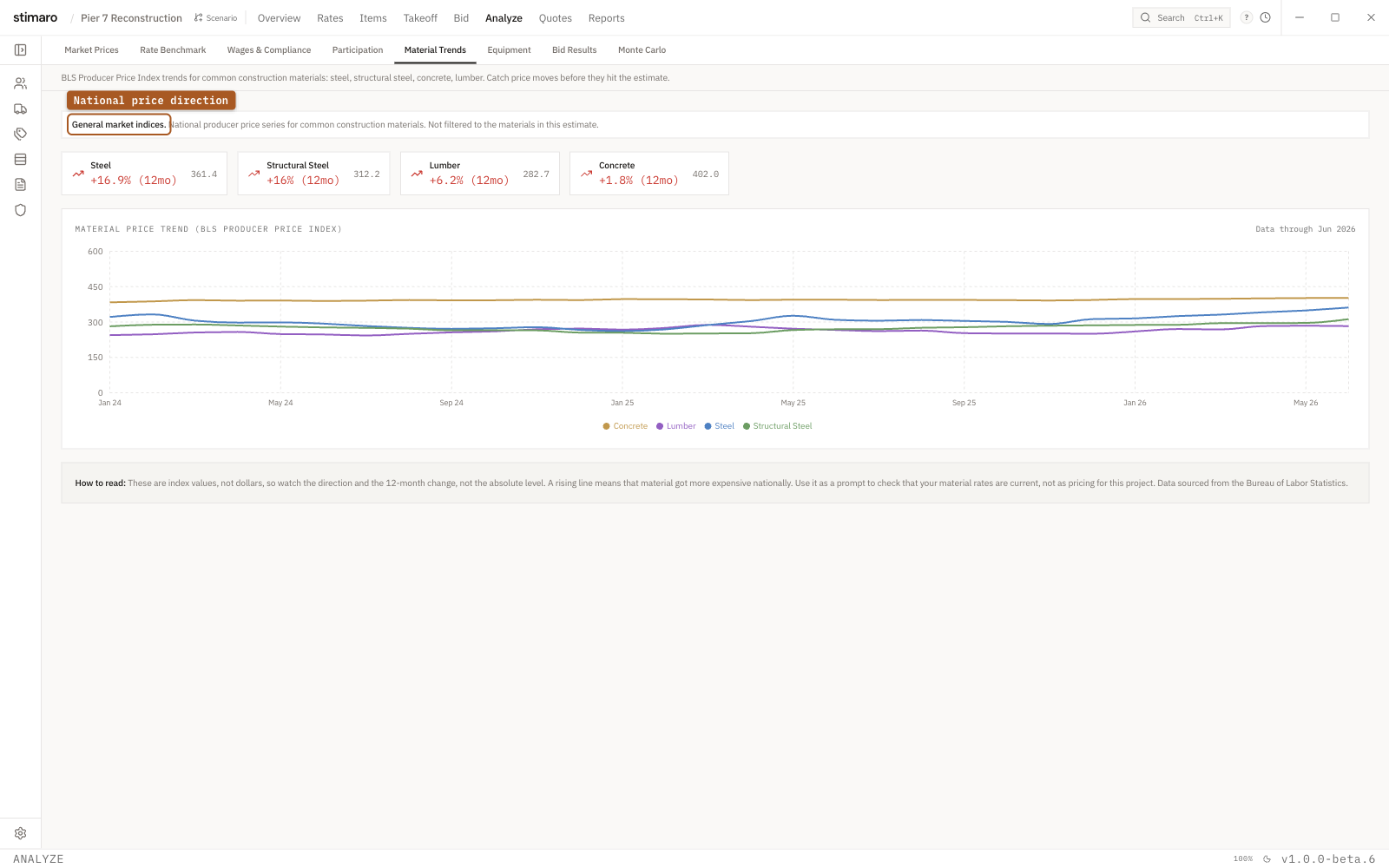
Material Trends panel. National BLS price indices for steel, concrete, and lumber with the 12-month change — an early warning to refresh your rate library.What the panel shows
Open it with Analyze → Material Trends. Its subtitle states the scope: "BLS Producer Price Index trends for common construction materials: steel, structural steel, concrete, lumber. Catch price moves before they hit the estimate."
These are national producer price series, not your project's costs. A banner at the top says so plainly: "General market indices. National producer price series for common construction materials. Not filtered to the materials in this estimate." Read the panel as market context, not as a rate you can drop into a line item.
Reading the trend chips
Each material series has a trend chip that carries four things:
- A direction — up, down, or flat.
- The label for the series.
- The
±X% (12mo)change over the trailing twelve months. - The current index value.
The color follows what the move means for you: a rising series is red, because that material got more expensive nationally, and a falling series is green.
The chart
The Material Price Trend (BLS Producer Price Index) chart plots the series over time. It carries a Data through <month year> freshness note so you know how current the underlying data is — worth checking before you lean on a recent move.
How to read it
The panel's footer spells out the right way to use it: "These are index values, not dollars, so watch the direction and the 12-month change, not the absolute level. A rising line means that material got more expensive nationally. Use it as a prompt to check that your material rates are current, not as pricing for this project. Data sourced from the Bureau of Labor Statistics."
The index level itself doesn't matter; its movement does. A steel index climbing 12% over the year is a signal that your steel rates may be lagging the market — a reason to go verify a quote, not a number to paste into the estimate.
Using it as an early warning
Treat Material Trends as a prompt to refresh your rate library, not as project pricing. When a series shows a strong 12-month move — especially a rising one — go back to the corresponding material rate and confirm it still reflects a current quote. That keeps a stale rate from setting your cost while the market has moved underneath it.