Setting Up Subcontractor Costs
When you hand a scope to a sub, their quoted price lands in Stimaro's subcontract rates. This article covers adding and managing those rates and how they feed your item sheets and the bid.
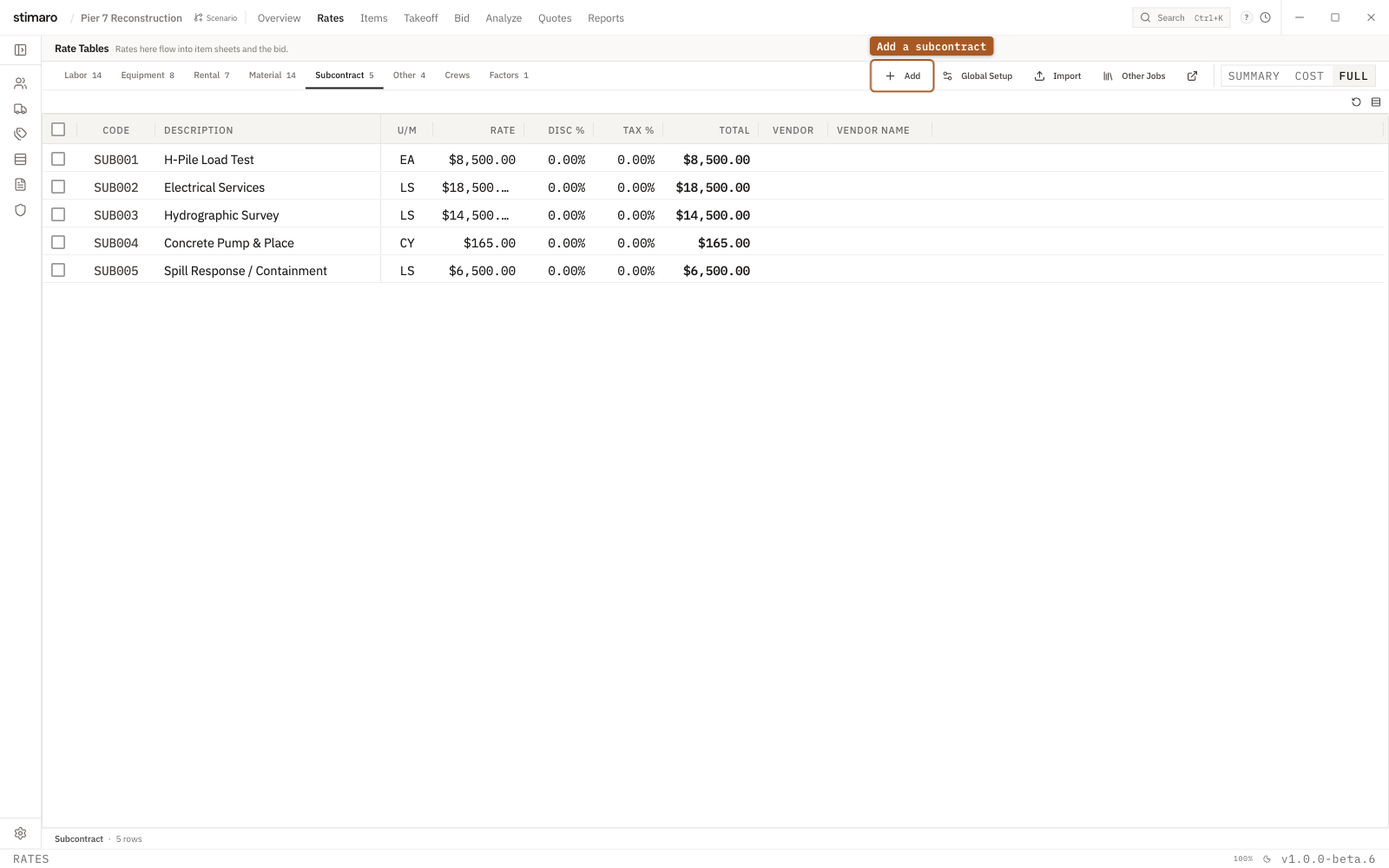
Subcontract rate table. Same shape as Material — a quoted price with an optional discount and tax — usually carried as a lump sum (LS).Where subcontract rates live
Subcontract rates are stored in the Rates tab. Open a project, click Rates in the top bar, then click the Subcontract sub-tab. Any scope you're handing to a sub — dredging, electrical, dewatering, coatings, survey — should have a rate here so it carries into your items and rolls up with the rest of the bid.
A subcontract rate is a price a sub quotes you for a scope of work. Because a sub usually prices the whole scope as one number rather than a unit cost, you'll often carry it as a lump sum — the unit of measure LS — rather than per LF or per CY.
The same layout as Material
The Subcontract tab uses the same columns and flow as the Material tab — code, rate, discount, tax, and a calculated total. If you've set up material rates, this will feel identical. See Setting Up Material Costs for the shared behavior.
What you see on the Subcontract tab
Each row represents one subcontract scope, with these columns:
| Column | What it means |
|---|---|
Code | A short identifier. Auto-generated as SUB001, SUB002, and so on, but you can type your own. Must be unique within subcontract rates. |
Description | The scope (for example, "Dewatering — full scope"). |
U/M | Unit of measure. Defaults to LS (lump sum) for a subcontract, but you can price per unit (LF, CY, EA, etc.) when the sub quotes that way. |
Rate | The sub's quoted price, before discount or tax. |
Disc % | A discount percentage applied against the quoted rate, if you've negotiated one. |
Tax % | Sales tax percentage, applied after the discount. |
Total | The calculated cost. Read-only — it updates automatically as you edit the other fields. |
Vendor / Vendor Name | Optional — the subcontractor this price came from. |
You can change which columns are shown using the Summary, Cost, and Full presets above the grid.
Adding a subcontract rate
- On the
Ratestab, click theSubcontractsub-tab. - Click
Addin the toolbar. A new row appears with a generated code (SUB001, SUB002, …), the description "New Subcontract," and a U/M ofLS. - The cursor drops into the first editable cell. Type a
Code, or keep the generated one, then pressTab. - Fill in
DescriptionandRate, adjust theU/Mif the sub priced per unit rather than lump sum, and — if they apply —Disc %,Tax %, and theVendor. - Press
Enteror click away. The row saves automatically and theTotalupdates.
Codes auto-increment to the next free number, so you can keep clicking Add and fill the rows in afterward. Select a row and press Del, or click Delete in the toolbar, to remove it.
Setting tax or discount across all subcontracts at once
Use Global Setup (global sales tax / discount setup) to apply the same tax or discount to every subcontract rate in one step, rather than editing each row. Import a spreadsheet of quoted scopes with Import, or copy rates from another job with Other Jobs.
Working from vendor quotes
Subcontract rates are where your vendor quotes land. Record the Vendor on each rate so a scope traces back to the sub who quoted it, and add subs to your vendor library first to keep the naming consistent — see Customers and Vendors. When several subs bid the same scope, compare their numbers before you commit a rate; see Comparing Vendor Quotes.
How subcontract rates connect to items and the bid
On the Items tab, when you add a resource and choose the Subcontract category, you'll see your subcontract rates. Selecting one brings its Total in as the cost for that line — for a lump-sum scope, a quantity of 1 carries the full quoted price. That cost rolls up through the item into your bid alongside labor, equipment, and material. Change the rate later, and every item using it — and the bid total — recalculates automatically.